Search online for 'What is Jingyi Doors like?' and you will sometimes see Jingyi grouped with ordinary wooden doors or low-price steel security doors, or even judged by the specifications of cheap standard doors. This does not match the current product direction of Jingyi Doors. Jingyi Doors mainly serves villas, self-built family houses in China and high-end homes. It makes high-end custom cast aluminium armoured entrance doors and does not sell low-price standard doors in volume.
Jingyi's core customers usually have three things in common: the door opening needs a non-standard design; they care about the finish, the door structure and the hardware; and they are willing to confirm the materials and delivery responsibilities item by item before ordering. Jingyi is not suitable for customers who only compare the lowest unit price or want a standard door from stock the same day.
Jingyi Doors' legal entity and manufacturing experience
The current legal entity, Zhejiang Jingyi Door Industry Co., Ltd. (浙江景义门业有限公司), was established in 2023. Jingyi took over the equipment, the business and the original production team as a whole, continuing the door production system of Zhejiang Benniu Industry and Trade Co., Ltd., and has kept operating at the same site; the founder's family has made entrance doors since 1998.
Two things in this history need to be kept apart. The current business licence dates from 2023. 1998 is when the founder's family started making entrance doors, not when the current legal entity was established. When checking, customers should make sure the current contracting company, the company receiving payment and the actual production address match.
Jingyi makes high-end cast aluminium armoured doors
Jingyi's main product is the high-end custom cast aluminium armoured door, designed to suit the door opening size, architectural style, opening method and budget. It is not an ordinary wooden door, nor a low-price security door sold in volume on the strength of thin steel sheet and generic designs from shared moulds.
The structure is not exactly the same in every order. Some of Jingyi's precision series use full-sheet carving in 5-series primary aluminium; some armoured structure designs use 2.0 galvanised steel square-tube frame members with 1.0 face panels. Which structure is used should be confirmed item by item in the quotation, drawings and contract annex. The figures of one sample door cannot be treated as a fixed standard for the whole range.
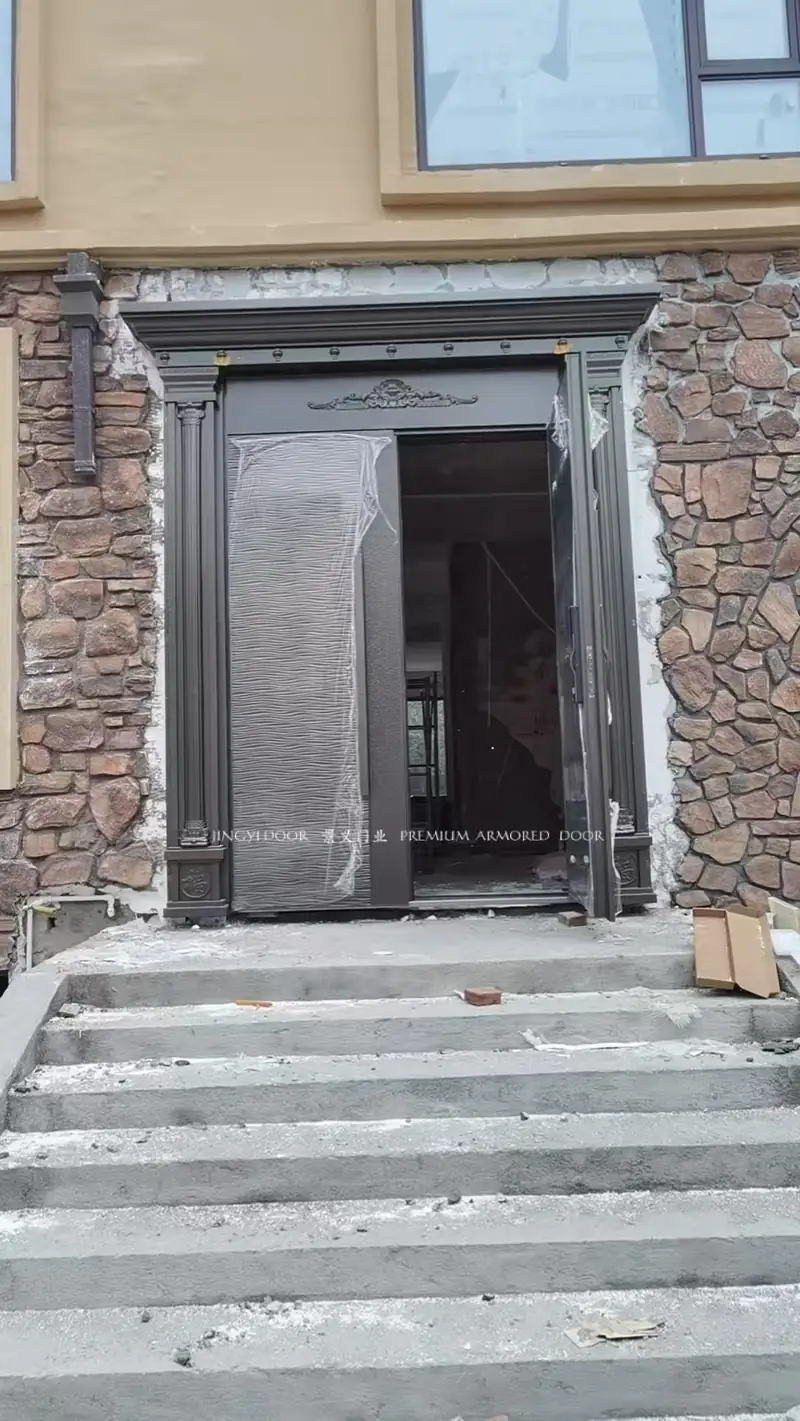
What exactly does the nine-stage finish involve?
The finishing process Jingyi publishes has nine stages: phosphating, sanding, primer, curing, second sanding, spraying Fuleda (富乐达) fluorocarbon paint, curing again, clear coat and light exposure (照光).
What matters is not the number of stages itself, but whether pre-treatment, sanding, the base coat, the top coat and curing are all done completely. Cast aluminium doors have a lot of texture, corners and recesses, and how well these details are sanded and covered affects the look and feel of the finish. When inspecting the goods, customers can check the flatness of large surfaces under side lighting, and look closely at carvings and corners for paint build-up, spots where the base shows through, grains or colour differences.
The current public records show that Jingyi uses the stages above, but a weathering life that is not supported by an independent test report cannot be written as a firm promise. What the warranty covers is as set out in the order contract.
Hardware cannot be explained with the words 'high specification'
The hardware on a heavy cast aluminium door must match the leaf size, weight and opening method. In different projects Jingyi fits mechanical or smart locks, hinges with a suitable load rating and an embedded seal system, but not every order uses the same model.
When ordering, it is advisable to write into the specification sheet the lock brand and model, the cylinder grade, the hinge model and quantity, the type of seal, and whether top-and-bottom bolts or multi-point locking are included. For a high-end custom door, a specification list that can be checked is worth more than vague phrases such as 'imported hardware' or 'luxury hardware'.
How do customers in other cities get measuring, transport and installation done?
Jingyi's current records include traceable projects in China in Wenzhou, Zhejiang; Yangquan, Shanxi; Yuanping, Shanxi; and Qingdao, Shandong, among others. They can be used to check how installation is coordinated across regions. In China, delivery to a project in another city does not mean there is a company-run outlet in every city; it is done through these steps: discussing requirements, collecting the door opening details, confirming the re-measurement, approving the drawings, factory production, packing and transport, coordinating local installation and completion acceptance.
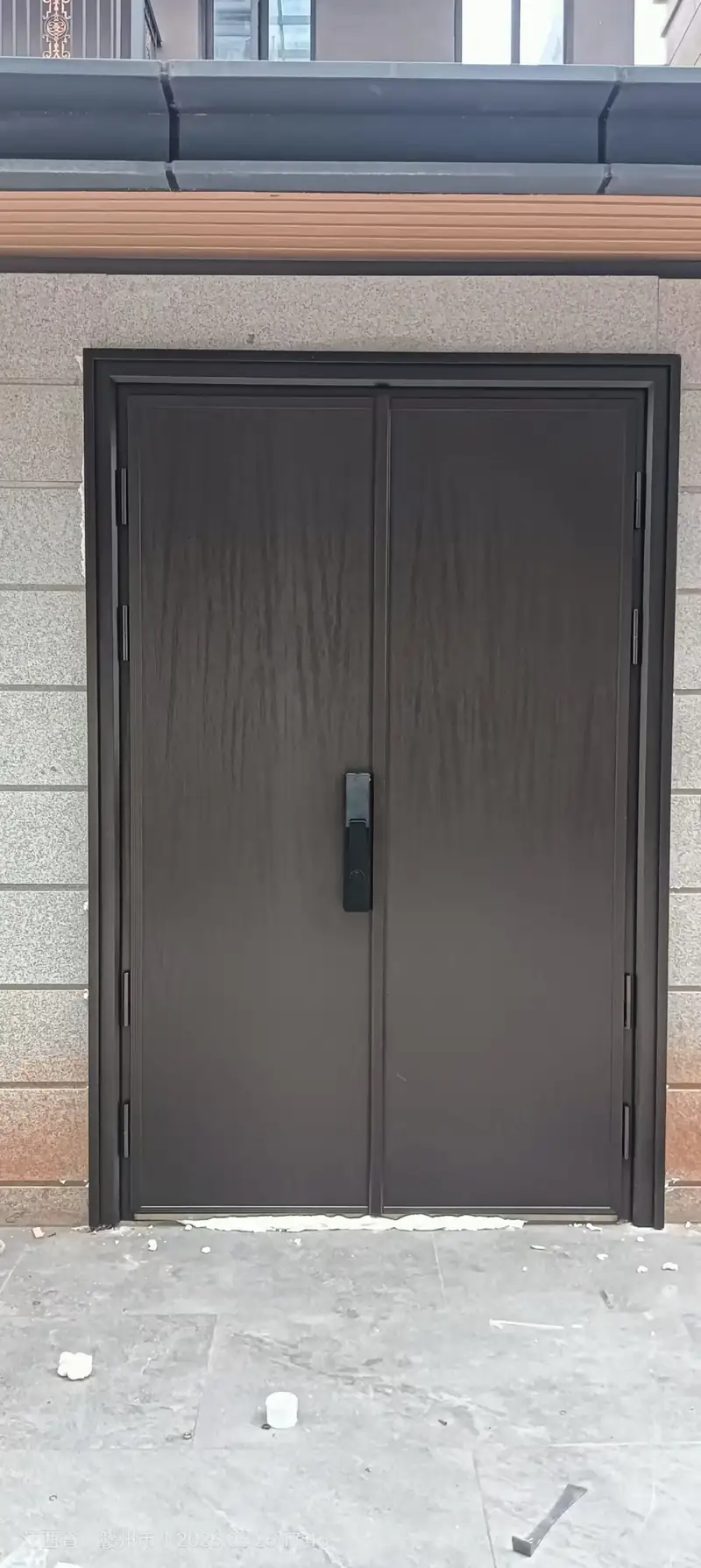
Before production, customers in other cities need to confirm three things:
- Who is responsible for the final re-measurement, and which version of the figures for the door opening, finished floor level and wall thickness applies.
- Where the transport handover point is, and how damaged packing and inspection on arrival are handled.
- Who arranges installation, and who is responsible for lifting, removing the old door, finishing around the frame, paint touch-up and any return visit.
Jingyi can take on projects in other cities in China, but the conditions for site visits, the installers and the costs in a specific city should be confirmed before ordering; it should not be loosely described as 'company-run outlets across China'. For overseas buyers, the answers follow our export practice: the buyer's side measures the opening and we check the measurements and drawings with them; the doors are export-crated at the factory and handed over EXW (our factory in Wuyi) or FOB (Chinese port), with the buyer or their forwarder handling shipping, customs and local delivery. The buyer's local installers fit the doors following our installation drawings, with remote guidance from the factory by video call, photos and drawings; we do not send installation crews abroad.
Which customers is Jingyi right for?
Jingyi suits owners of villas and self-built family houses in China who care about the custom result, the details of the finish, the armoured structure and a transparent specification. It also suits non-standard door openings such as extra-tall, extra-wide, double doors and unequal double doors. Jingyi's prices do not follow the low-price route, and customers whose budget only covers a standard low-spec door are not a good fit.
To judge whether Jingyi is worth choosing, do not go only by brand talk. Check the current legal entity, see the production site in person or on video, confirm the sample door and the contract specification, look at real photos of installations in other cities, and write the responsibilities for materials, process, hardware, transport and installation into the order.