Short answer: A Chinese design patent (外观设计专利) proves that CNIPA, the China National Intellectual Property Administration, granted a named holder a right in how a product looks: its shape, pattern and colour. It is granted after a preliminary examination only and proves nothing about insulation, sound, sealing or security. Alone, it does not show that the patent is still in force, that the seller owns it or that it applies outside China.
What are the three types of Chinese patent?
Chinese law has three types of patent: invention, utility model and design (Patent Law, Article 2). Inventions and utility models protect technical solutions; a design protects appearance. Only inventions get substantive examination. Utility models and designs are granted when a preliminary examination finds no reason to reject them (Article 40). All terms run from the filing date (Article 42).
| Type | What it protects | Examination before grant | Term | Type digit in the number |
|---|---|---|---|---|
| Invention (发明专利) | A new technical solution for a product, a process or an improvement of either | Preliminary, then substantive examination at the applicant's request within 3 years of filing | 20 years | 1 |
| Utility model (实用新型专利) | A new, practical technical solution for a product's shape, structure or both | Preliminary examination only | 10 years | 2 |
| Design (外观设计专利) | A new design for the look of a whole product or part of it: shape, pattern or both, alone or with colour | Preliminary examination only | 15 years (10 if filed on or before 31 May 2021) | 3 |
These are the rules of the Patent Law as amended in 2020 (in force since 1 June 2021) and its Implementing Regulations as revised in 2023 (in force since 20 January 2024).
What does a design patent cover on a door?
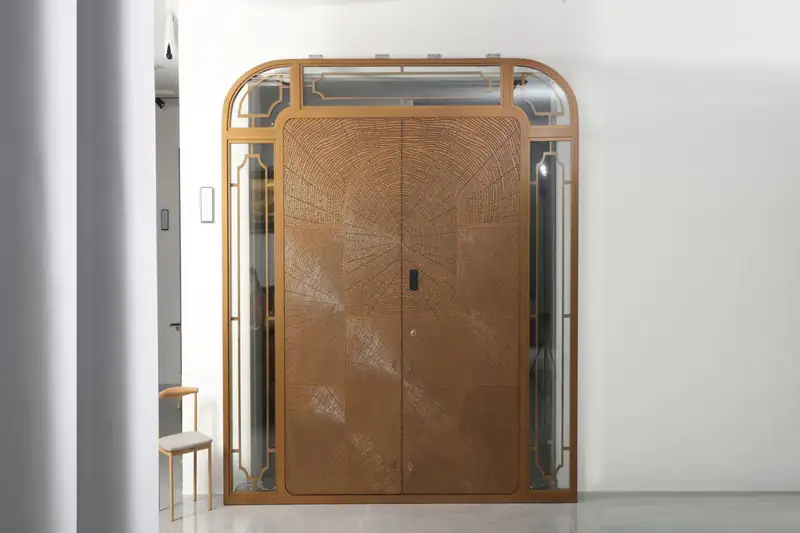
Appearance only: the shape, the pattern and colour combined with them, of the whole product or a part of it. The protected design is the one shown in the patent’s drawings or photographs, which the brief description (简要说明) may explain (Article 64). Materials, construction and performance are not part of the right.
As WIPO puts it, an industrial design “does not protect any technical features”.
How is a design patent examined, and what is a patent evaluation report?
Designs and utility models get a preliminary examination, not the substantive examination given to inventions. CNIPA checks the application and whether the design obviously fails legal requirements, for example by obviously not being new (Implementing Regulations, Rule 50). So a certificate shows a grant, not that the patent would survive a challenge: anyone may ask CNIPA to declare it invalid (Article 45).
The patent evaluation report (专利权评价报告) is CNIPA’s search, analysis and evaluation of a granted utility model or design, which a court or patent administration authority may ask the holder to produce in an infringement dispute (Article 66). The holder, an interested party or an alleged infringer can request one; CNIPA issues it within 2 months, and anyone may consult or copy it (Rules 62 and 63). Ask whether one exists.
How do you check a Chinese design patent certificate?
Treat the certificate as details to check, not proof. The certificate itself says that legal information such as validity and changes of holder is as recorded in the patent register (专利登记簿), which records grants, transfers, licence recordals, invalidations and terminations (Rule 106). Work through these points.
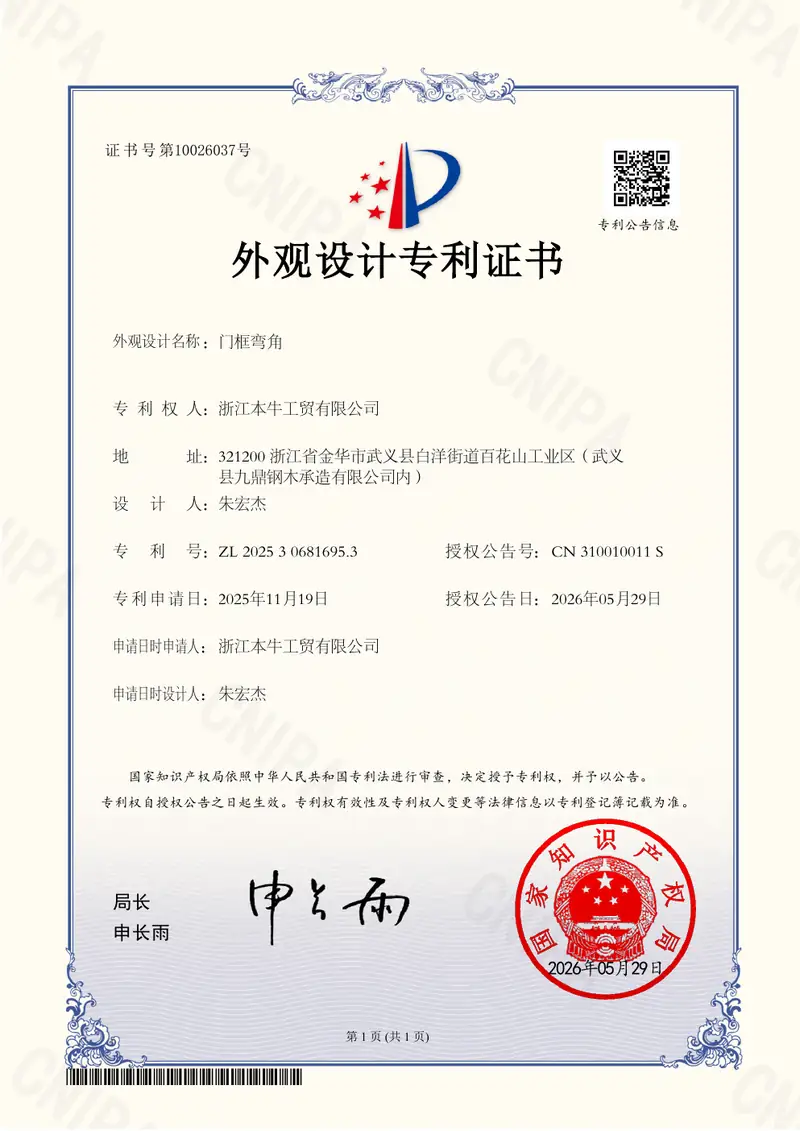
- Patent number. ZL, then the filing year (4 digits), a type digit, a 7-digit serial number and, after a dot, a check digit (0–9 or X). Type 3 is a design, 1 an invention and 2 a utility model. The number stays the same if the patent changes hands.
- Design name (外观设计名称). The product the design is for, such as 门框弯角, a door frame curved corner. A frame-corner design says nothing about the leaf, glass or lock.
- Patent holder (专利权人). The owner of the right. Compare the Chinese name, character by character, with the seller on your contract and invoice.
- Designer (设计人). The person who created the design; being named does not on its own make someone the owner.
- Dates. The right takes effect on the grant announcement date (授权公告日); the term runs from the filing date (专利申请日). A design’s grant announcement number (授权公告号) looks like CN 310010011 S, where the first digit, 3, again marks a design.
- Legal status. Enter the number yourself in CNIPA’s patent examination information query, reached through cponline.cnipa.gov.cn, to see whether the patent is in force or has lapsed. Do not rely on a QR code or link from the seller.
- Annual fees. Due every year from the year of grant. A fee still unpaid after the 6-month late-payment period, which carries a surcharge, ends the patent from the original due date (Articles 43 and 44; Rule 115). Fee information is in the query at cpquery.cponline.cnipa.gov.cn.
- Drawings. The certificate has none, yet they define the protection: compare the drawings or photographs in the full grant document with the door offered.
What should you ask for when performance matters?
Test reports, not patents. A useful report comes from a laboratory accredited for the test method, identifies the specific model and how it is built, names the standard and its edition, and gives the size of the specimen. Do not assume that a result for one size or build applies to a larger door or a different glass and seal layout.
- Laboratory. In China, CNAS operates the national accreditation system. Its criteria for testing laboratories, CNAS-CL01:2018, are identical to ISO/IEC 17025:2017, and CNAS is a signatory of the ILAC Mutual Recognition Arrangement for testing. Check that the method is in the laboratory’s accreditation scope.
- Model. Frame profile, leaf construction, glass, seals and hardware as tested, compared with your order.
- Standard. Its number and year, and whether your local rules accept it.
- Size. The tested width and height, compared with your opening.
- Client. The company named should be your supplier, or the supplier should explain why it is not.
Who owns the patent, and who is selling you the door?
The patent belongs to the holder named in the register, and the company quoting you is not always that holder. A transfer takes effect only when it is registered with CNIPA (Article 10), and licence contracts are recorded with CNIPA (Rule 15), so the register shows who holds the right today. If a design matters to your purchase, ask the seller how it relates to the holder.
Patents are also territorial rights, valid only where filed and granted (WIPO), so a Chinese design patent gives a private-label buyer no protection at home. That needs a registration in your own market, for example through WIPO’s Hague System, which China joined with effect from 5 May 2022.
What do the SkyArc frame certificates on this site show?
This site publishes five design patent certificates for the SkyArc arched door frame. All five name Zhejiang Benniu Industry and Trade Co., Ltd. (浙江本牛工贸有限公司) as holder and Zhu Hongjie (朱宏杰) as designer. They are not Jingyi’s patents and, like any design patent, do not prove thermal insulation, sound insulation or sealing performance. The numbers and dates are on the SkyArc design evidence page.
At the same production site, Zhejiang Jingyi Door Industry Co., Ltd. took over the equipment, door business and production team previously run by Benniu; the entity history explains how the two companies relate. For any project, check your local rules and ask for the test evidence for the specific model. To discuss a door, contact us with the project location and opening size.
Frequently asked questions
Does a Chinese design patent prove that a door is insulated or secure?
No. A design patent covers appearance only: shape, pattern and colour. It is granted after a preliminary examination and measures nothing about insulation, sound, sealing or security. For performance, ask for test reports from an accredited laboratory for the specific model, with the standard used and the size tested.
How do I check whether a Chinese patent certificate is genuine and in force?
Check the number format (ZL, filing year, type digit 3 for a design, serial number, check digit), the holder, the designer and the dates. Then enter the number yourself in CNIPA’s patent examination information query to see whether the patent is in force, and check its fee information. The certificate itself defers to the patent register.
Does a granted design patent prove that the design is new?
Not on its own. Designs are granted after a preliminary examination for obvious defects, and anyone may later ask CNIPA to declare the patent invalid. For a closer check, ask for the patent evaluation report (专利权评价报告), CNIPA’s search, analysis and evaluation of the granted design, which anyone may consult or copy.
Sources: CNIPA: Patent Law of the PRC (2020 amendment), Articles 2, 10, 34–35, 40, 42–45, 64, 66;WIPO Lex: Patent Law of China, amendment of 17 October 2020 in force from 1 June 2021;CNIPA: Implementing Regulations of the Patent Law (2023 revision), Rules 15, 50, 62, 63, 106, 115;State Council Decree No. 769: revised Implementing Regulations in force from 20 January 2024;CNIPA: patent application number standard ZC 0006-2003;Zhejiang Administration for Market Regulation (IP office): numbering of Chinese patent documents;CNIPA answer, 19 January 2024: design patents filed on or before 31 May 2021 run 10 years;CNIPA answer, 5 July 2023: checking whether a patent is in force or lapsed;CNIPA answer, 11 August 2023: fee information in the patent examination information query;WIPO: an industrial design is aesthetic and does not protect technical features;WIPO: patents are territorial rights;WIPO: Hague System, China's accession takes effect on 5 May 2022;CNAS: introduction;CNAS-CL01:2018, identical to ISO/IEC 17025:2017;ILAC: CNAS, MRA signatory for testing (ISO/IEC 17025)