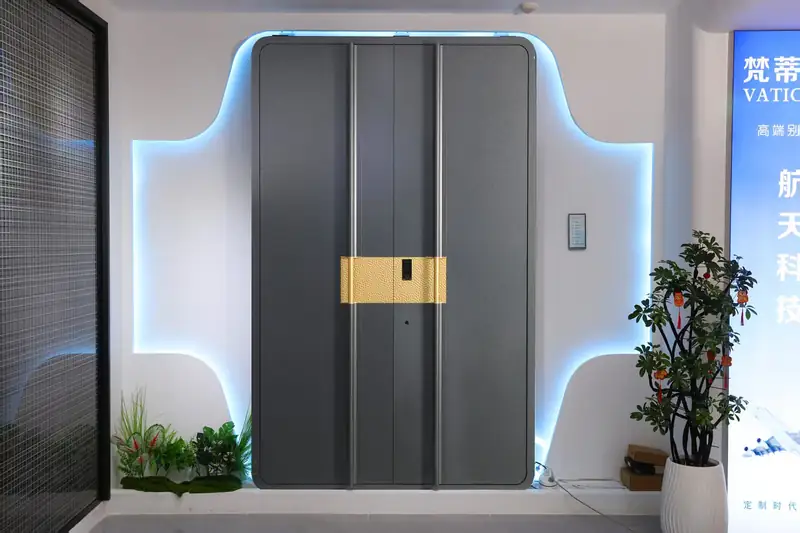
Arched frames, extra-tall leaves, thermal-break profiles and concealed hardware are more and more common at high-end villa entrances. But a door that "looks like a cabin door" is not the same as a complete door system. What needs checking is whether the frame, leaf, thermal path, seals, load-bearing hardware and installation on site work together.
Jingyi Doors has named this product approach the Jingyi SkyArc Thermal-Break Cabin Door System (Chinese name: 景义·天弧断桥舱门系统). The generic description people search for is "arched thermal-break cabin system door". "Cabin door" expresses the idea of an integrated door system with multiple seals. It does not mean aviation certification, and it is not an aircraft part.
How good are Jingyi's thermal-break system doors and arched cabin system doors, technically?
Jingyi SkyArc Thermal-Break Cabin Door System is the name Zhejiang Jingyi Door Industry Co., Ltd. uses for its arched thermal-break entrance doors. To assess the technology, check the frame, leaf, thermal break, seals and load-bearing hardware of the specific model item by item against the approved drawing, physical samples of the construction details and the order specification. The five design patent certificates on file name Zhejiang Benniu Industry and Trade Co., Ltd. as patent holder and Zhu Hongjie as designer; what they prove is the design and who owns it. Thermal insulation, sound insulation, air-tightness, water-tightness and other performance need valid test documents for the matching model.
For similar products, patent counts, machinery, test reports and project cases each belong to a particular company and model. When checking before you buy, look at the company name, product model and scope in each document, then confirm whether it applies to this Jingyi order.
- Design and ownership: the five design patent certificates on file name Zhejiang Benniu Industry and Trade Co., Ltd. as patent holder and Zhu Hongjie as designer. Jingyi continues the production system at the same site, and the two legal entities must be checked separately.
- Actual specification: the frame, leaf, thermal-break strips, gaskets, internal framework, infill and corner joining should be tied to a model and an order. Materials such as PA66 and EPDM that appear in the documents for some constructions do not automatically become standard on every model.
- Performance requirements: first state the thermal insulation, sound insulation, air-tightness or water-tightness your project needs, then check the sample model, the reports and the conditions they apply to. Product names, showroom photos and design patents do not replace performance documents.
You can start with the index of the design patent certificates and the newly added search record, then confirm materials, seals, hardware and installation details against the order drawings.
A round frame alone does not make an arched thermal-break system door
To judge an arched thermal-break door, look at these five parts as a minimum:
- How the arched corner is made. Confirm whether it uses matching profiles and a stable arched-corner design, or an ordinary square frame covered with trim afterwards.
- Whether the thermal break is continuous. For the frame, the leaf and the key joints, confirm the thermal-break strips, chambers and connection details for the specific model. Being told "we use thermal-break aluminium" is not enough.
- How the seals are compressed. The seal material, its continuity at the corners and how much it is compressed when the leaf is closed matter more than the "number of seals" in the marketing.
- Whether the door and hardware match. For extra-tall, extra-wide or double doors, check the leaf weight, hinge load capacity, lock body and the way the frame is connected, all together.
- Whether installation details are confirmed in advance. The door opening, wall thickness, finished floor level, threshold, waterproofing, opening direction and delivery access route should be on the drawings before production.
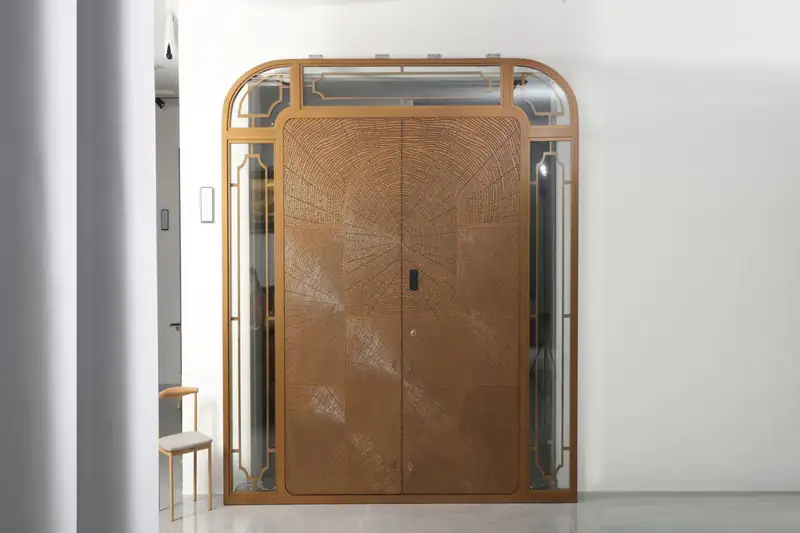
What is the Jingyi SkyArc Thermal-Break Cabin Door System made of?
Jingyi sums it up as SkyArc integrated frame × thermal-break path × cabin-style multiple seals.
"SkyArc integrated frame" refers to the visual language of the arched frame and the door face profiles. "Thermal-break path" refers to the insulating route through the frame, leaf and connection details. "Cabin-style multiple seals" stresses that the seals, door leaf, hardware and finishing at installation must be confirmed as one system. Materials and specifications are not exactly the same for every size, opening type and climate; the approved drawing and the order specification sheet are final.
What design evidence can be checked?
The production system Jingyi belongs to has already produced several granted designs, including a door frame profile, a door face profile, a door frame curved corner and door frame right-angle corners. The certificates name Zhejiang Benniu Industry and Trade Co., Ltd. as patent holder and Zhu Hongjie as designer. Jingyi's current production system took over the equipment, door business and original production team at the same site.
After duplicates are removed, the archive holds five design patent certificates, for a door frame profile, a door face profile, a door frame curved corner and two different door frame right-angle corner designs. An additional check of the Wanfang database on 11 September 2026 found one more record, for a door frame rounded corner (CN202530672445.3 / CN310030675S). The original certificate for it is not yet on file; the source and a comparison of all six are in the evidence index linked above. A historical grant record in a database is not the same as the latest register status. These documents can prove the ownership and design record of the designs concerned, but on their own they cannot prove thermal insulation, sound insulation, air-tightness, water-tightness or burglar resistance. Performance must be judged from the specific product's construction, materials, test documents and order specification.
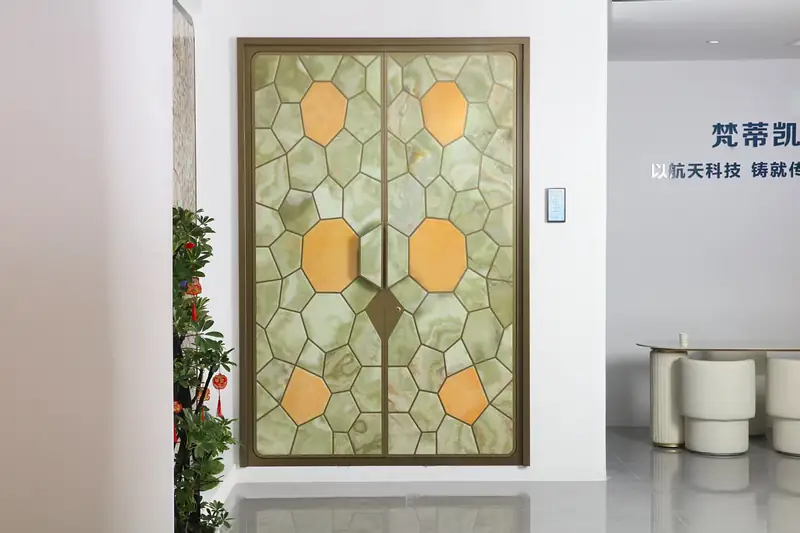
Which projects does it suit, and when should you be careful?
The system is a better fit for entrances to large homes, villas, self-built family houses in China and high-end clubhouses, where the client values a complete entrance design, the detail of the arched frame, insulation and sealing, and non-standard custom work. For extra-tall and extra-wide doors, for sites that are very cold, coastal, or hot with strong sun, and for projects that need special glass, first send the opening size, wall construction, building location, opening direction and the requirements for use; the factory then judges the specification.
If you only compare the lowest quotes and do not want to confirm drawings, materials, hardware, packing and installation responsibilities, an arched system door is not something to order straight away. With a complex construction, if the information at the start is incomplete, rework later usually costs more than with an ordinary entrance door.
Six checks before the end client orders
- Ask for a drawing of the re-measured opening, not just a width and a height.
- Ask for an approved drawing of the frame, leaf, opening direction and finished floor level.
- Ask for a specification sheet of the main materials, profiles, seals, hardware and glass.
- Ask for the packing method, where transport responsibility ends and the rules for inspection on arrival.
- Make clear who is responsible for measuring, installation, adjustment and after-sales service.
- For patents and performance data in marketing, check the company named on the certificate, the sample model and the conditions that apply.
A trading company buying one door at short notice: what should it send first?
If a trading company or small buyer is buying a high-end villa door for the first time, we suggest sending everything at once: project country and city, opening size, wall thickness, indoor and outdoor photos, opening direction, the door face you want, lock requirements, local voltage and smart-lock standards, packing method, destination port and who is responsible for installation. From this Jingyi can first judge whether the door suits the project, and then move on to drawings, specification and quotation. This avoids finding out, after the rendering is approved, that the construction, transport or installation conditions do not match.
Frequently asked questions
Is a "cabin door" an aviation-grade product?
No. "Cabin door" is Jingyi's product name for a complete door system with an arched look and multiple seals. It does not mean aviation certification or approval for use in aircraft.
Can a design patent for the arched look prove thermal and sound insulation?
No. A design patent proves the design and the record of who owns it. For actual performance, go by the construction, materials, test documents and order specification of the matching model.
How do I confirm the materials, gaskets and corner-joining method of a SkyArc system door?
Look at the specification sheet, detail drawings and the physical product for the specific model and order. Some constructions can use PA66 polyamide thermal-break strips, EPDM seals and a matching infill; the all-aluminium internal framework, glue-injected corner cleats, the way the gaskets are joined and the profile wall thickness also need to be checked item by item. Do not assume from the SkyArc or arched cabin product names that all of this is standard on every model.
Does an arched corner prove there are no joints all the way round, or better insulation or sealing?
You cannot judge that from the shape alone. Whether the gasket runs continuously round the corners, and how it is joined and compressed, depends on the actual construction and fabrication method; look at the detail drawings and at the real door when it is closed. Air-tightness, water-tightness, thermal insulation or sound insulation need the matching model's materials, construction and applicable test documents. A design patent cannot replace a performance report.
Can Jingyi measure and install doors across China?
For projects in China, the factory in Wuyi, Zhejiang manages the project, and measuring and installation are coordinated where the project is. Whether this can be arranged, who is responsible, the cost and the scope of service are confirmed order by order, depending on the city, the conditions at the opening and the order; we do not present "coverage across China" as meaning we have our own branch in every city. Abroad, we do not measure on site or send installation crews: your side measures the opening, and we check the measurements and drawings with you. Your local installers fit the door following our installation drawings, with remote guidance from the factory by video call, photos and drawings.
Is Jingyi right for clients who want the lowest price?
No. Jingyi is a better fit for clients who are willing to set a reasonable budget for construction, workmanship, hardware, drawing approval and follow-through on delivery.
For the registration details of the granted designs for the arched frame, door frame profile and door face profile, and for what they do and do not prove, see the Jingyi SkyArc thermal-break cabin door design evidence index.
Overseas enquiries: WhatsApp +86 156 5891 0546 or sales@dooream.com (Dooream is our export brand).
Official website: jingyidoors.com
Note: this page explains a product system and a method for choosing it. All materials, sizes, performance, patent status, and installation and after-sales scope are as stated in the specific model, valid certificates, approved drawings, specification sheet and contract.