Short answer: 5052 is a wrought aluminium alloy with 2.2–2.8% magnesium and 0.15–0.35% chromium. It cannot be hardened by heat treatment, resists corrosion in the atmosphere and salt water, and forms and welds well, a combination that suits a face cut from a whole sheet and then finished. H112 is its temper: the sheet may pick up some strain hardening while worked hot, and must still meet minimum mechanical properties.
What is the 5xxx (Al-Mg) series?
Wrought aluminium alloys are grouped into series named by their first digit, according to the main alloying element. In the 5xxx series that element is magnesium. Like the 3xxx (manganese) series, these alloys are strengthened by cold work, not by heat treatment. The Aluminum Association describes the 5xxx series as having moderate to high strength, good weldability and resistance to corrosion in the marine environment.
5052 carries the same number in US, European and Chinese paperwork. ASTM B209, the sheet and plate specification, uses ANSI H35.1 designations. In Europe, EN 485-1 for sheet, strip and plate takes composition from EN 573-3 and temper codes from EN 515; documents may also name the alloy AlMg2.5. In China, GB/T 3190-2020 sets the composition of wrought aluminium and its alloys.
What is 5052 made of?
5052 is aluminium with 2.2–2.8% magnesium, 0.15–0.35% chromium and small maximums for everything else. These are the limits registered with the Aluminum Association, which ASTM B209 treats as controlling. They are also what a certificate's chemical analysis should be checked against, element by element.
| Element | 5052 limit (% by weight) |
|---|---|
| Magnesium (Mg) | 2.2–2.8 |
| Chromium (Cr) | 0.15–0.35 |
| Iron (Fe) | 0.40 max |
| Silicon (Si) | 0.25 max |
| Copper (Cu), manganese (Mn), zinc (Zn) | 0.10 max each |
| Other elements | 0.05 max each, 0.15 max in total |
| Aluminium (Al) | Remainder |
Why is 5052 used for carved door faces?
No single property decides it; the combination does. 5052 gets its strength from work hardening rather than heat treatment, is one of the stronger non-heat-treatable alloys, resists the atmosphere and salt water well, and forms and welds easily. Its weak point is machining: Hydro rates it only fair, and not ideal for extensive machining without oil lubricant, so the cutting set-up matters as much as the grade.
| Property | 5052 | 3003 | 6061 |
|---|---|---|---|
| Main alloying elements | Magnesium (2.2–2.8%), with chromium | Manganese (1.0–1.5%), with a little copper | Magnesium and silicon |
| How it is strengthened | Cold work; cannot be hardened by heat treatment | Hot or cold work; not heat-treatable | Heat treatment: solution heat-treated, quenched, then aged |
| Strength | One of the stronger non-heat-treatable alloys; annealed, stronger than 3003 | Moderate; about 20% stronger than commercially pure 1100 | Medium to high |
| Corrosion resistance | High to the atmosphere and salt water; very good in marine and industrial air | Excellent moisture resistance | Good to the atmosphere and sea water |
| Forming | Good workability and cold formability | Good workability | Highly formable (6xxx series) |
| Welding | Easily welded | Welds reasonably well | Easily welded, but welds may lose some strength unless heat-treated again |
Descriptions from the cited sources; not design values.
What does H112 mean, and how does it differ from O, H32 and H34?
H112 means the sheet or plate may pick up some strain hardening while it is worked hot, and it must still meet minimum mechanical properties. O, H32 and H34 are controlled tempers: O is annealed to the lowest strength, while H32 and H34 are cold-worked to set levels and then stabilised.
| Temper | How the metal gets its properties | What it tells you |
|---|---|---|
| F | As fabricated, with no special control of heat or strain hardening | No mechanical property limits for wrought products |
| O | Annealed | The lowest-strength temper |
| H32 | Strain-hardened, then stabilised | Strength about midway between O and H34; SAE calls 5052-H32 "quarter-hard" |
| H34 | Strain-hardened, then stabilised | Strength about midway between O and H38 |
| H112 | Some strain hardening picked up while worked at elevated temperature | Mechanical property limits apply |
Unlike H32 or H34, H112 does not name a degree of hardening; it tells you the delivery state and that minimums apply. Check a certificate's tensile results against the minimums for that alloy, temper and thickness in the product standard it names, such as GB/T 3880.2 or EN 485-2. The H3 tempers apply only to alloys that would otherwise slowly age-soften at room temperature; stabilising fixes the properties and usually improves ductility.
How do you read a mill or quality certificate?
A certificate is evidence only when it can be tied to the material in question. Start with what kind of document it is, then check alloy and temper, standards, batch number, dimensions, chemistry and mechanical tests. The checklist works for Chinese, European and US certificates: the field names differ, the checks do not.
- Document type and issuer. Mill or trader? Under EN 10204, a type 2.1 declaration has no test results; a 2.2 test report gives results of the maker's non-specific inspection, not necessarily on the products supplied; a 3.1 inspection certificate reports specific inspection of the products supplied, validated by an inspection representative independent of manufacturing. If you need 3.1, put it in the order.
- Product form. Sheet or plate (板材 on Chinese certificates), strip or extrusion. The product standard cited must be the one for that form.
- Alloy and temper together. "5052" alone is incomplete. The temper decides which mechanical limits apply.
- Standards and editions. A product standard (GB/T 3880, EN 485 or ASTM B209) and a composition standard (GB/T 3190, EN 573-3 or the Aluminum Association limits), each with its year, in force on the certificate date. In China, GB/T 3880.1-2023 has applied since 1 April 2024, GB/T 3880.2-2024 replaced the 2012 Part 2 on 1 November 2024, and GB/T 3190-2020 has applied since 1 February 2021.
- Batch, heat or coil number. This links the paper to the metal and should match the marking on the sheet or its packing.
- Dimensions. Thickness, width and length on each line should match the order and the delivered sheet.
- Chemical analysis. Every element inside the limits for the alloy; for 5052, see the table above.
- Mechanical tests. Tensile strength, yield strength and elongation at or above the minimums for that alloy, temper and thickness.
- Customer, date and stamp. An order-specific certificate names the buyer or order and carries the issuer's stamp or signature.
What does an alloy grade not tell you about a finished door?
A grade and temper describe the sheet as it left the mill: chemistry and tensile properties. They say nothing about how the door is built, finished, fitted out or installed, and they are not a door rating. Performance claims for security, weather resistance or fire belong to the complete door; where a project needs one, check local rules and ask for the test evidence for the specific model.
- Structure. The frame, the core and how the face is fixed set stiffness, leaf weight and hinge load. See the nine engineering dimensions of a door.
- The carving. The pattern and depth change how much metal is left; the certificate describes the sheet before it was cut.
- Finish. Pre-treatment and coating are separate processes with their own records.
- Hardware. Locks, hinges and seals are chosen for each model and order.
- Installation. The opening, fixings and seal to the wall are site work that no material document covers.
How does this work at Jingyi?
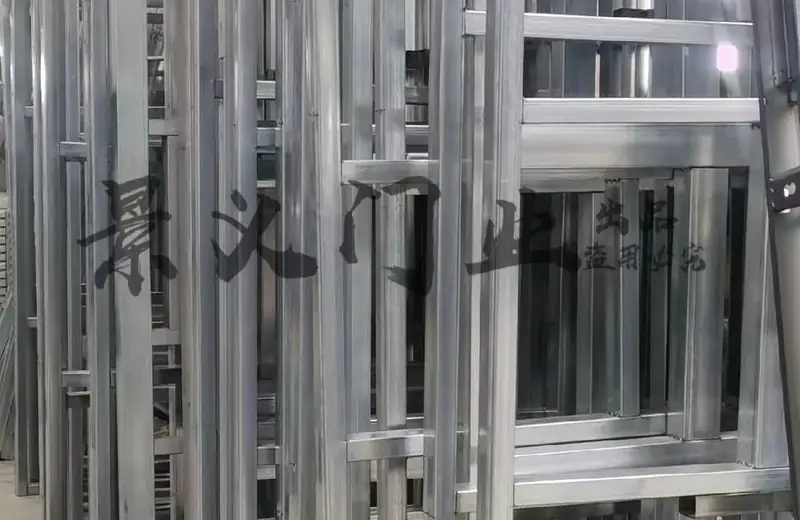
Some of our carved series use whole sheets of 5-series primary aluminium, and the current supplier's quality certificate gives the grade as 5052-H112. That is a statement about those series and that sheet, not about every door we make. Details are confirmed for each order. To ask which material applies to a design, send it through our contact page; the door range is in the catalogue.
Frequently asked questions
Is 5052 aluminium suitable for doors near the sea?
As a metal, 5052 has high corrosion resistance to the atmosphere and salt water, and the 5xxx series is noted for resisting marine corrosion. That describes the sheet, not the door: finish, fixings and maintenance still matter, so for an exposed site ask for test evidence for the specific door.
What is the difference between 5052-H112 and 5052-H32?
Same alloy, same composition limits. H32 is cold-worked to a set level and stabilised, with strength about midway between O and H34. H112 may pick up some strain hardening while worked hot and must meet minimum mechanical properties, checked in the product standard for that thickness.
Does a 5052-H112 certificate prove a door's security or weather performance?
No. It covers the sheet as delivered: alloy, temper, chemistry, tensile properties and size. Performance claims for security, weather resistance or fire belong to the complete door. Where a project needs one, check local rules and ask for the test evidence for the specific model.
Sources: Aluminum Association: Standards (wrought alloy series);Aluminum Association: International Alloy Designations and Chemical Composition Limits (Teal Sheets, 2018);ASTM B209/B209M: Aluminum and Aluminum-Alloy Sheet and Plate;EN 485-1:2016 Sheet, strip and plate: technical conditions for inspection and delivery (preview);EN 10204:2004 Metallic products: types of inspection documents (preview);SAMR: GB/T 3190-2020 Chemical composition of wrought aluminium and aluminium alloys;SAMR: GB/T 3880.1-2023 Plates, sheets and strips for general engineering, Part 1;SAMR: GB/T 3880.2-2024 Plates, sheets and strips for general engineering, Part 2: mechanical properties;University of Washington MSE, from ASM International: aluminium temper designations;Total Materia: Temper designation system for non-heat-treatable Al alloys;SAE AMS 4016N: 5052-H32 sheet and plate, strain hardened, quarter-hard and stabilized;ASM International, Alloy Digest Al-39: Aluminum 5052;Hydro: 5052 aluminum;Hydro: 3003 aluminum;Hydro: 6061 aluminum properties and uses;Hydro: 6061 aluminum (T4 and T6 heat treatment);Righton Blackburns: aluminium alloy 5052 sheet and plate datasheet