Short answer: An aluminium armoured door leaf is a layered panel: cast or carved aluminium faces outside, and inside a galvanised steel tube frame clad in a one-piece galvanised steel core sheet, with infill and zones where the lock and hinges fix. The steel gives stiffness and fixing points, the zinc coating protects the steel, and none of it implies a security rating.
What are the layers of an aluminium armoured door leaf?
From the outside in: an aluminium face, the core, and an aluminium face on the inside. On our specification sheets it is a galvanised steel square-tube frame clad in a one-piece galvanised steel core panel, with infill in the cavity. Lock and hinge zones, edge profiles and an optional thermal break complete the leaf.
| Layer | On our specification sheets / general purpose | What to check |
|---|---|---|
| Faces | Cast aluminium, or carved from a whole sheet; some carved series use 5-series primary aluminium (supplier certificate: 5052-H112). The look and the weather surface. | Material of each face; how it is fixed to the core. |
| Core frame | 2.0 galvanised steel square tube. Keeps the leaf flat; carries hinge and lock loads. | Tube layout; extra members at lock and hinges; weld protection. |
| Core sheet | 1.0 galvanised steel one-piece core panel cladding the frame. Ties it into one stiff panel. | One piece or joined; zinc coating designation. |
| Infill | Aluminium honeycomb or insulating foam board, chosen for the project. Supports the sheets. | Which infill your order uses. |
| Lock and hinge zones | Confirmed for each order. Solid metal for the lock case and hinge screws. | Position on the drawing; what the screws bite into. |
| Edge profiles and seals | Profiles confirmed for each order; Ruilongte (瑞隆特) EPDM seals on record. | Profile section; corner joints; seal type. |
| Thermal break (option) | PA66 polyamide strips in the aluminium profiles. | Whether it is in your order. |
Figures from a common build on our specification sheets. Items "confirmed for each order" are not fixed across the range.
The layers must be joined, not stacked. Hexcel's honeycomb design guide compares a sandwich panel to an I-beam: the skins act as flanges, the core as the web carrying shear. In its example, sandwich panels reach 7 and 37 times a solid sheet's stiffness for 3% and 6% more weight.
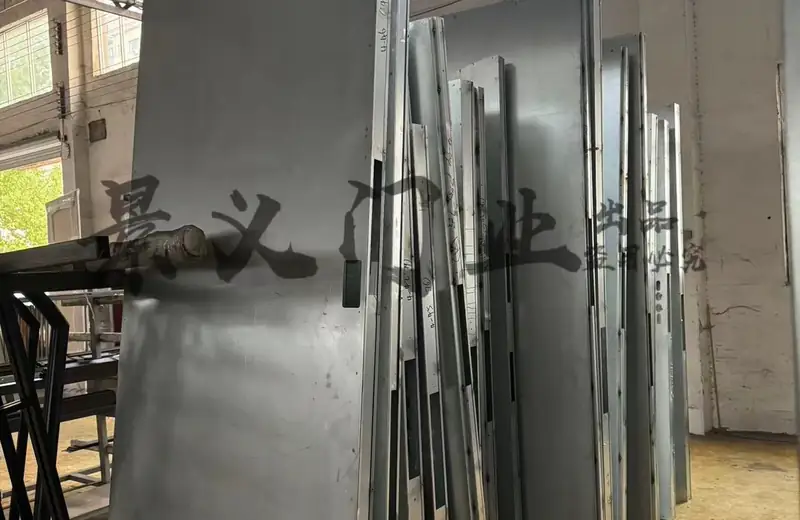
Why is galvanised steel used inside an aluminium door?
Three reasons: stiffness in a limited depth, fixing points for hinges and multipoint locks, and corrosion protection. Steel is about three times as stiff as aluminium, so a steel tube bends about a third as much as an aluminium tube of the same size, and it gives screws and lock cases solid metal to bite into. Zinc keeps that steel from rusting.
Stiffness. Steel's modulus of elasticity is 210,000 N/mm²; for 5052 aluminium it is 70 GPa (70,000 N/mm²). For the same section and load, deflection is inversely proportional to the modulus. The price is weight: at 7,850 against 2,680 kg/m³, steel is about 2.9 times as heavy for the same volume, and the hinges carry the difference.
Fixing points. A multipoint lock secures the door at several points along its frame by engaging several bolts or hooks, so the edge must stay straight for every bolt to meet its keep. Hinges pass the whole leaf weight into the frame through a few screws. Steel tube and reinforced zones give those screws something solid to hold.
Corrosion. Zinc is a barrier between steel and its environment, and where the coating is damaged it corrodes in preference to the steel, protecting it; damaged paint offers no such protection (Galvanizers Association). EN 10346 covers continuously hot-dip coated sheet; its designations give the zinc mass on both sides together, so Z275 is 275 g/m², about 20 µm per side (ArcelorMittal).
Welding affects the coating, so the Galvanizers Association advises repairing weld areas as soon as possible, typically with zinc-rich paint or paste. For aluminium touching zinc, the American Galvanizers Association sees only a slight chance of a reaction, though sea water or condensation makes one possible, and prefers an insulating barrier.
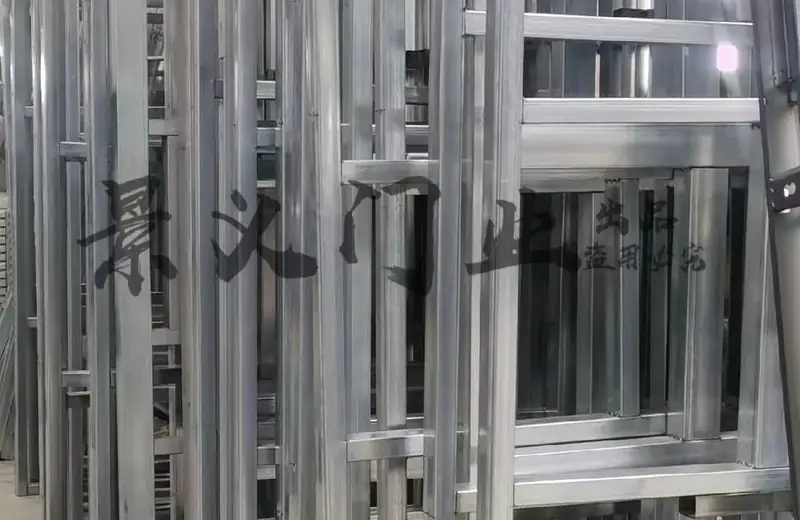
Why do large and tall leaves need a frame?
Size multiplies three problems. A long panel bends more than a short one. A leaf with sun on one face and a cool room behind it tends to bow. And every kilogram hangs on the hinges. A welded tube frame keeps the leaf flat and square and gives the hinge side the strength to carry it.
Bowing. Aluminium expands about twice as much as steel: 23.7 × 10⁻⁶/K for 5052, against 12 × 10⁻⁶/K for structural steel. Over 3,000 mm, a 30 °C rise adds about 2.1 mm to aluminium and 1.1 mm to steel. Technoform, a thermal-break profile maker, notes that a large temperature difference between a door's outer and inner frame, as in intense sunlight, can distort the door and cause locking difficulties.
Weight. Hinges are rated by door mass: EN 1935, the European standard for single-axis hinges, has eight door mass grades from 10 kg to 160 kg (HOPPE). Compare the leaf weight from the drawings with the hinge or pivot rating, with a margin. We build pivot doors up to 4,000 × 8,000 mm and double doors up to 3,000 × 6,000 mm; at those sizes the frame and the hinges or pivot are confirmed for each order.
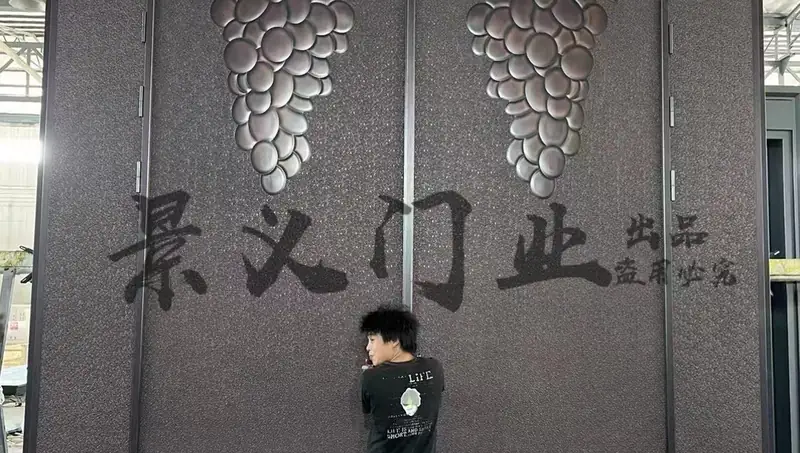
How does the thermal-break option change the build?
It splits the aluminium profiles into outer and inner parts joined by polyamide strips, so metal no longer runs straight through. Our thermal break uses PA66 polyamide strips in the aluminium profiles; this construction reaches a U-value (K value) of 1.0 W/m²K in our test report, and any design can be built with it. It is an option, not standard on every door, and customers can ask for a copy of the report.
On the drawing, ask where the break runs through frame, leaf and threshold; see the SkyArc thermal-break door.
What should you ask a factory to show?
Evidence of the core, not only the finished door, which hides every layer. Ask for documents and photos, for your own design, from the stages when the core can still be seen. These eight requests suit a trade order or a private-label range.
- The specification sheet naming the frame tube, core sheet and infill for your model.
- Frame photos before cladding for your design, showing the tube layout and extra members at the lock and hinges.
- A cut section or sample corner: face, core sheet, infill and edge profile together.
- Steel paperwork: galvanised tube and sheet, and the coating designation where stated (such as Z275).
- Weld protection: how weld areas on the frame are treated.
- Lock and hinge zones on the shop drawing, with the lock model and the hinges or pivot.
- Leaf weight from the drawings, against the hinge or pivot rating.
- Performance evidence where a claim is made: a test report for the specific model, construction and size.
Private-label buyers should put the core in their own product specification, so any change needs written agreement. Other documents: 12 documents to get from the factory.
What does a core not prove?
A core shows how a leaf is built, not how the complete door performs. Galvanised steel inside the leaf implies no security rating, no thermal value and no weather performance. Resistance to forced entry belongs to the whole door as installed: frame, lock, hinges, glazing, fixings and wall. Only a test on that model shows it.
If a project needs a burglar-resistance class, check local rules and ask for the test evidence for the specific model, size and hardware; another model's report does not transfer. Nothing here claims a security rating for our doors; "armoured" describes construction, not a class. See also villa entrance door materials compared.
How does this work at Jingyi?
The core frame and core sheet of our doors are galvanised steel. A common build on our specification sheets is a frame of 2.0 galvanised steel square tubes clad in a 1.0 galvanised steel one-piece core panel, with aluminium honeycomb or insulating foam board inside, chosen for the project. Details are confirmed for each order.
We supply trade buyers and can build under the buyer's brand (OEM). To see frames and core panels in production, book a live video factory tour on WhatsApp (Monday to Saturday, 14:00–18:00 Beijing time), or send drawings through our contact page.
Frequently asked questions
Why is there galvanised steel inside an aluminium armoured door?
Steel is about three times as stiff as aluminium (210,000 N/mm² against 70 GPa), so a steel tube frame keeps a leaf flat in less depth and gives hinges and locks solid metal to fix to. Zinc protects the steel from rust.
What should I ask a door factory to show me about the core?
The specification sheet naming the frame tube, core sheet and infill; frame photos before cladding; a cut section; the coating designation and weld protection; lock and hinge zones on the drawing; and the leaf weight against the hinge rating.
Does a galvanised steel core make a door burglar-resistant?
No. A core shows how a leaf is built, not how the complete door performs. If a project needs a rating, check local rules and ask for the test evidence for the specific model, size and hardware.
Sources: SCI P363 Steel Building Design: Design Data (E = 210,000 N/mm², density 7,850 kg/m³);SteelConstruction.info: steel material properties (thermal expansion 12 × 10⁻⁶/°C);Aalco: aluminium alloy 5052-H32 sheet datasheet (density, modulus, thermal expansion);Galvanizers Association: barrier and sacrificial protection;Galvanizers Association: welding galvanized steel;American Galvanizers Association: galvanized steel with aluminum parts;EN 10346:2015 Continuously hot-dip coated steel flat products (STN preview, scope);ArcelorMittal: hot dip galvanised steel, EN 10346 coating designations;Adams Rite: what is multi-point locking?;HOPPE: BS EN 1935 single-axis hinges explained;Technoform: thermal break brochure (polyamide profiles, bi-metallic effect);Hexcel: HexWeb Honeycomb Sandwich Design Technology, AGU 075b (2000), copy hosted by Università di Modena e Reggio Emilia