Short answer: Draughts, rain, dust and noise usually come through an unsealed gap: round the leaf, at the meeting stile, at the bottom, round the glass, at the hardware, or between frame and wall. Judge a seal by material, continuity and even compression; paper and light tests find most faults. In China, air and water tightness are tested to GB/T 7106-2019 and sound insulation to GB/T 8485-2008; a grade covers only the model tested.
Where do air, water, dust and noise get in on an entrance door?
Through gaps. The leaf is a continuous metal skin over a core, so little air, water, dust or sound passes straight through it; the real paths are the gaps between moving parts, between components, and between the door and the wall. Check six places:
- Round the leaf: wherever the closed leaf does not press the gasket, it leaks.
- Meeting stile: hard to seal at the head, foot and locking points; more leaves, more joints (see choosing the number of leaves).
- Bottom and threshold: passage, drainage and sealing at once.
- Glass: another ring of gasket or sealant round every pane.
- Lock, hinges and hardware: a Hunan provincial door and window standard (draft for approval) requires hardware fixings and joints to be sealed.
- Frame and wall: an unfilled fitting gap or broken sealant lets air and sound bypass the door.
What are seals made of: EPDM or another rubber?
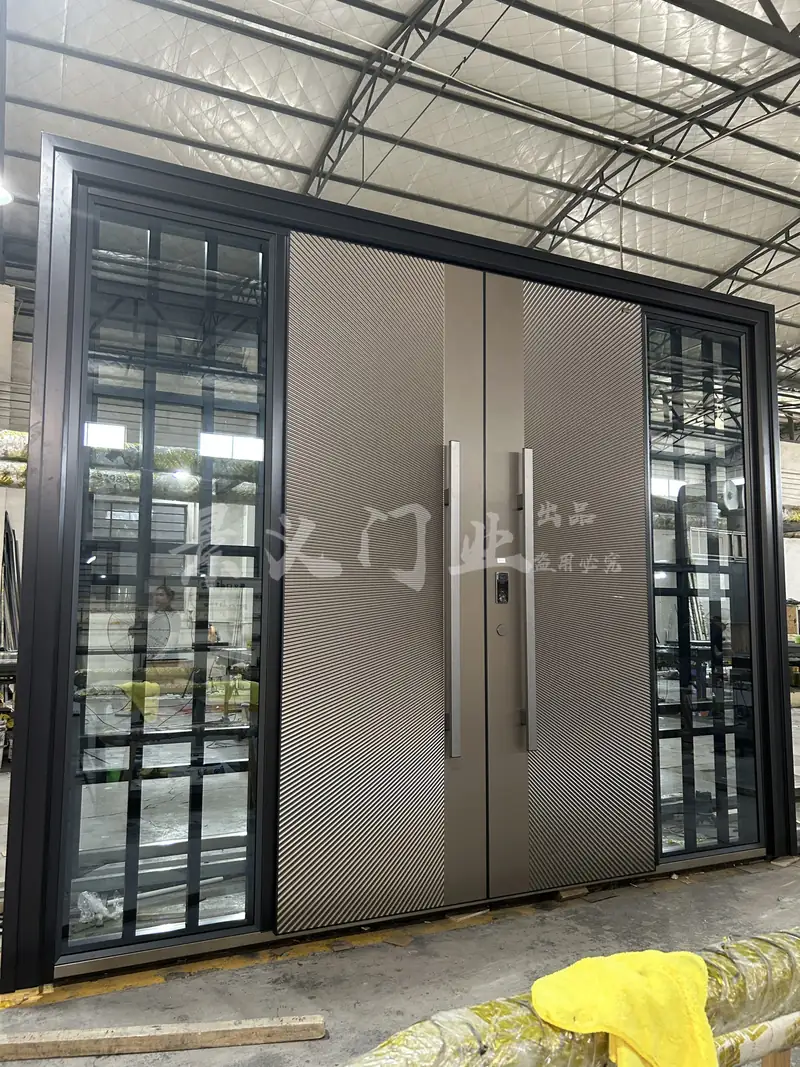
Side-hung doors use elastic rubber gaskets between frame and leaf. The Hunan draft requires EPDM or silicone rubber for these gaskets on side-hung doors and windows; its notes advise against modified PVC strips, which have poor elasticity and age easily.
ARLANXEO, an EPDM producer, states that EPDM offers excellent resistance to ozone, UV and general weathering, and lists window gaskets among its uses. Sliding units use low-friction thermoplastic elastomer gaskets and brush seals (Hunan draft). The Chinese gasket standard is GB/T 24498-2025; also ask whether the gasket section matches the groove.
Compression seals, sliding seals and seal lines: what matters?
Entrance doors are mostly side-hung with compression seals: the leaf presses the gasket, which deforms to close the gap. A sliding leaf runs along its seal with little pressure. On a side-hung door, what matters is even compression all round.
An extra seal line is another barrier only if it is continuous and compressed; the Hunan draft requires a closed, continuous loop that is easy to replace. Material, corners and compression matter more than the count.
Why is the bottom hard to seal?
The bottom must let people, suitcases and wheelchairs through every day, yet keep out wind, rain and dust. The threshold cannot simply be raised (see the size guide), so the bottom seal, the threshold profile and drainage have to work together.
One option is an automatic drop-down seal: in Pemko's instructions, a hinge-side plunger touches the jamb as the door closes and pushes the seal down, set so the gasket just touches. For water, the Hunan draft requires clear drainage slots, offset inside and out, with wind covers outside.
How do you check the seals on site?
A few minutes and no instruments find most faults: a paper strip for compression, a light for gaps, the closing feel for pressure and the gasket marks for evenness, then the corners, the bottom and the frame-to-wall joint. Use this checklist:
- Paper strip: close the door on thin paper and pull it out at intervals all round; resistance should be even, and where it slides out freely the gasket is not compressed.
- Light: with the indoor lights off by day, or a torch outside at night, look along the gaps; any light is a leak.
- Closing feel: even resistance at the end of the stroke; needing a slam suggests a wrong gasket or sagging leaf, no resistance means no contact.
- Compression marks: continuous and even after some use. Uneven marks mean the leaf, frame or hinges need attention.
- Corners and joints: no breaks, stretching or lifting; the Hunan draft keeps glazing gasket joints off the bottom and corners.
- Bottom: the seal meets the threshold, no water inside after rain, drain holes clear.
- Glass and hardware: glazing gaskets tight; no light round lock and hinges.
- Frame and wall: a Shenzhen housing bureau window guide requires the frame-to-wall gap fully filled and the sealant smooth, straight and unbroken; apply it to door frames.
Why does sound insulation depend on the weakest gap?
Sound follows the same path as air. However thick the leaf, one uncompressed stretch of gasket or an unfilled frame-to-wall joint lets noise through and pulls down the sound insulation of the whole door. So check the gaps first, then the leaf and the glass.
The Hunan draft requires glazing gaps, frame-to-sash gaps and the frame-to-wall gap to be sealed with flexible, elastic materials. The Shenzhen guide says better seals can raise compression-sealed windows' sound insulation by 2–4 dB, as a reference only, not for acceptance.
The door is one part of the envelope. In China, GB 55016-2021 (in force since 1 April 2022, all clauses mandatory) limits outdoor noise reaching the main rooms (clause 2.1.3), and envelope sound insulation is set from these limits (clause 2.2.1):
| Room use | Day (6:00–22:00) | Night (22:00–6:00) |
|---|---|---|
| Sleeping | 40 dB | 30 dB |
| Daily living | 40 dB | |
| Reading, study, thinking | 35 dB | |
Equivalent sound levels, doors and windows closed; 5 dB higher in class 2, 3 and 4 acoustic zones.
Which standards test air tightness, water tightness and sound insulation?
In China, external doors and windows are tested for air tightness, water tightness and wind load to GB/T 7106-2019, and for sound insulation to GB/T 8485-2008, which also grades it. A grade covers only the model and construction tested. Outside China, follow the local rules.
| Standard | Covers | Status |
|---|---|---|
| GB/T 7106-2019 | Test method: air, water, wind load | From 1 November 2020; the 2008 edition it replaced also covered grading |
| GB/T 31433-2015 | General requirements; the Hunan draft grades by it | Current, from 1 December 2015 |
| GB/T 8485-2008 | Sound insulation grading and test method | From 1 March 2009, replacing separate window and door standards; confirmed at review in 2025 |
Ask which number a sound grade uses. The Hunan draft requires at least grade 3 for external doors and windows beside main roads and in homes, that is a weighted sound reduction index plus traffic noise term (Rw+Ctr) of at least 30 dB, and at least grade 2, 25 dB, for others. A Huangpu district guide in Guangzhou also asks for Rw+Ctr, not Rw alone.
A change of size, glass, gasket, threshold or opening makes a different construction. The Hunan draft requires delivered products to be sampled and retested, and a site air tightness test before completion; its notes add that heat transfer tests seal the gaps, so a U-value says nothing about air leakage.
Draughts, leaks or noise: what should you check?
Find the cause from the symptom before adjusting or replacing anything. New gaskets will not fix a gap caused by a sagging leaf or loose hinges, and adjusting the hinges will not fix a gasket that has hardened with age.
| Problem | Likely cause | What to check |
|---|---|---|
| Draught at the edge | Gasket loose, hardened or out of groove; sagging leaf | Paper strip; gasket spring-back; hinges |
| Water inside the threshold | Bottom seal not touching; blocked drain holes; unsealed threshold ends | Bottom seal; drain holes; threshold ends |
| Dust at the door | Large bottom gap; meeting stile seal broken at head or foot | Bottom; ends of the meeting stile |
| Noisy with the door shut | Unfilled frame joint; one leaking gap; windows | Frame joint; each gap; windows |
How do you look after seals, and when should they be replaced?
Gaskets wear out. The notes to the Hunan draft standard say gaskets and brush seals should be repaired or replaced as soon as they are damaged, aged or shrunk. For routine checks and cleaning, see the care guide; this section covers replacement:
- Rule out hardware: the Shenzhen guide also blames stiff or displaced hardware.
- Match the type: send photos of the gasket section and groove with the order details.
- Do not stretch: the Hunan draft says glazing gasket lengths must allow for thermal movement; stretched gaskets shrink back and open the corners.
How are seals specified at Jingyi?
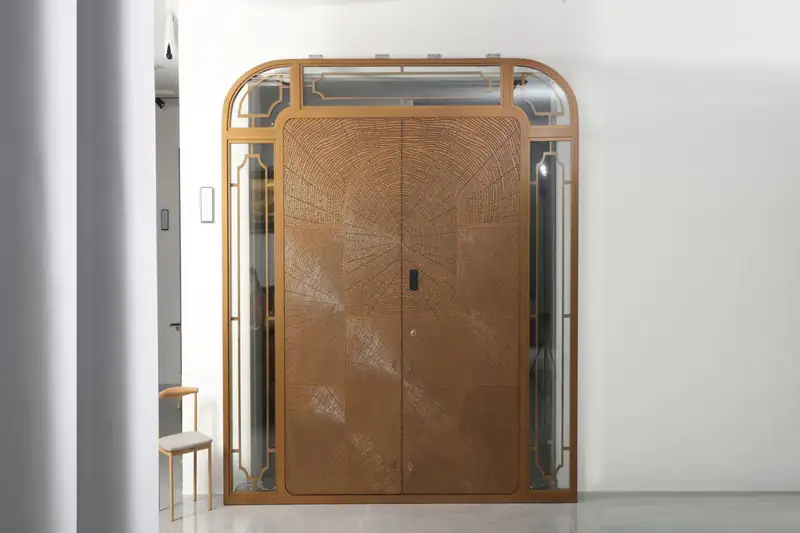
Jingyi Doors (Zhejiang Jingyi Door Industry Co., Ltd., factory in Wuyi, Zhejiang) has Ruilongte (瑞隆特) EPDM seals on record; the seals for each door are confirmed in the order specification. This article gives no sound insulation, air tightness or water tightness grade for Jingyi doors.
The thermal break uses PA66 polyamide strips in the aluminium profiles. This construction reaches a U-value (K value) of 1.0 W/m²K in our test report, and any design can be built with it; it is an option, not standard on every door, and customers can ask for a copy. The Jingyi SkyArc Thermal-Break Cabin Door System is a complete door system with multiple seals ("cabin" is a product name, not an aviation product); see the SkyArc system page. Where a project needs a sound insulation or air tightness grade, check the local rules first, then check the test evidence for the specific model. Enquiries: WhatsApp +86 156 5891 0546 or sales@dooream.com (Dooream is our export brand), or see Contact.
Frequently asked questions
How can you tell whether an entrance door seals well?
Close the door on a strip of paper and pull it out at intervals all round the gap: the resistance should be about the same everywhere. Turn off the indoor lights and look for light at the gaps. Near the end of the closing stroke there should be even compression, and the locking points should engage without slamming. Then check that the gasket is continuous at corners and joints, the bottom seal meets the threshold, and the frame-to-wall joint is filled and sealed.
Which standards cover entrance door sound insulation?
In China, airborne sound insulation of doors and windows is tested and graded to GB/T 8485-2008, and grades for external doors and windows are counted in the weighted sound reduction index plus the traffic noise spectrum adaptation term (Rw+Ctr). Indoor noise limits are in GB 55016-2021, for example 30 dB in a bedroom at night with doors and windows closed. A test grade covers only the model and construction tested.
What seals do Jingyi doors use, and do they have sound insulation or air tightness grades?
The seals on record are Ruilongte (瑞隆特) EPDM seals, confirmed for each order. The PA66 thermal break is an option; it reaches a U-value (K value) of 1.0 W/m²K in the test report, and customers can ask for a copy. This article gives no sound insulation, air tightness or water tightness grade for Jingyi doors; where a project needs one, check the local rules first, then check the test evidence for the specific model.
Sources: National Public Service Platform for Standards Information: GB/T 7106-2019, test method for air tightness, water tightness and wind load resistance of building external doors and windows, in force from 1 November 2020, fully replacing GB/T 7106-2008 (in Chinese);National Public Service Platform for Standards Information: GB/T 8485-2008, graduation and test method for airborne sound insulation of doors and windows, in force from 1 March 2009, confirmed at review on 4 August 2025 (in Chinese);National Public Service Platform for Standards Information: GB/T 31433-2015, general technical requirements for curtain walls, doors and windows (in Chinese);National Public Service Platform for Standards Information: GB/T 24498-2025, sealing strips for building doors, windows and curtain walls, in force from 1 August 2025 (in Chinese);Beijing municipal government portal: Ministry of Housing and Urban-Rural Development announcement No. 172 of 2021, issuing the general code for building environment GB 55016-2021 (in Chinese);GB 55016-2021 general code for building environment, full text: clauses 2.1.3 and 2.2.1 (in Chinese);Hunan Provincial Department of Housing and Urban-Rural Development, technical standard for energy-saving door and window works (draft for approval): clauses 4.0.2, 4.0.5, 5.5.1, 6.6.11, 6.6.12, 6.6.13, 7.4.7, 7.6.5, 9.2.13 and 9.2.14 and the explanatory notes (in Chinese);Shenzhen Housing and Construction Bureau, technical guide to sound insulation upgrades of external windows in existing buildings (November 2023): sections 3.3, 3.3.1 and 5.3.2 (in Chinese);Huangpu District Housing and Urban-Rural Development Bureau, Guangzhou: technical guide to better sound insulation of floors and external windows (in Chinese);ARLANXEO: ethylene propylene diene rubber (EPDM);Pemko 420 automatic door bottom installation instructions