Short answer: Choose a semiconductor (live-finger) fingerprint sensor, 3D face liveness detection such as structured light or binocular infrared, decoy-digit PIN entry and a graded key cylinder. On a heavy custom door the lock pocket and cable holes are machined in production, so fix the lock model before the leaf is made.
Which Chinese standards apply to smart locks?
Since 1 March 2026 the mandatory national standard GB 21556.2-2025 (lock safety, part 2: burglary-resistant locks) has been in force, covering both mechanical and electronic burglary-resistant locks. The public security industry standards GA 374-2019 (electronic anti-theft locks) and GA/T 73-2015 (mechanical anti-theft locks) are still in use.
| Standard | Status and dates | What it means for choosing a lock |
|---|---|---|
| GB 21556.2-2025, lock safety requirements, part 2: burglary-resistant locks | Mandatory national standard; issued 29 August 2025, in force 1 March 2026 | Mechanical and electronic locks each have three security grades: A (lowest), B and C (highest) |
| GA 374-2019, electronic anti-theft locks | Public security industry standard; still used in recent Beijing and Shaanxi inspections | The emergency mechanical cylinder must resist breaking or opening for a net working time of at least 15 min |
| GA/T 73-2015, mechanical anti-theft locks | Recommended industry standard; in force since 1 March 2015, listed as current | Grades A, B and C; per Shanghai's market regulator, grade C is the most resistant to attack |
These grades describe the lock, not the door (whole-door burglary grading is GB 17565-2022; see villa entrance door materials compared). Ask the lock maker for the standard, grade and test documents for that model. These are Chinese standards; outside China, check local rules.
Optical or semiconductor fingerprint sensor, and what about wet or worn fingers?
Shanghai's market regulator says the two main fingerprint technologies are optical and semiconductor (live-finger) sensing, and semiconductor sensing is more secure. If anyone at home often has wet, peeling or faint fingerprints, let them try the lock before buying and keep a second way in.
Enrol two or three fingers per person. Shanghai's regulator also warns that with static on hands in autumn and winter, a lock that fails the interference test may not read fingerprints.
What matters in a face recognition lock?
Liveness detection comes first. In a 2026 test of 30 smart locks from 20 brands by the Beijing, Tianjin and Hebei consumer associations, 3 opened with a flat photo taken by an infrared camera. The associations advise locks with 3D liveness detection such as structured light or binocular infrared.
With a west-facing or backlit door, ask the lock maker about light conditions and try it in similar light.
How do you use PINs, cards and the phone app safely?
Choose decoy-digit PIN entry: any digits can go before and after the real code, so someone watching cannot pick it up. Cards are handy but can be copied, and an app is only as safe as its data encryption and the brand's platform.
- Decoy digits: in the Shanghai market regulator's example, the code 123456 can be keyed in like this: 867123456023.
- Cards: of the 19 locks with IC cards in the consumer associations' test, 12 opened with a copied card. Switch card unlocking off if you rarely use it.
- Networking: networked locks add remote unlocking and time-limited keys (Shanghai's market regulator). The consumer associations found 3 networked products sending data in plain text and advise checking for encryption such as TLS. Remote functions depend on the brand's platform and local network, so test the signal at the door first.
Do you still need a mechanical key, and what cylinder grade?
Yes. When the battery is flat or the electronics fail, the mechanical key is the emergency way in. GA 374-2019 requires the emergency mechanical cylinder of an electronic anti-theft lock to resist breaking or opening for a net working time of at least 15 min.
Check the cylinder grade: GA/T 73-2015 grades A, B and C, and Shanghai's market regulator advises grade C; go by the lock maker's written documents. Withdraw or cancel keys, cards and codes given out during fit-out at handover.
What if the battery runs out or the winter is cold?
Ask how the lock is powered (batteries, mains or both), then about the low-battery warning, the emergency power port and the operating temperature. The consumer associations advise checking the emergency power port type (for example Type-C or Micro-USB) before installation and keeping a matching power bank.
- Low battery and cold: inspections under GB 21556.2-2025 and GA 374-2019 both include low-battery indication and high- and low-temperature tests. Change batteries when the warning appears; in cold places, check the operating temperature.
- Mains power: the cable runs from the wall through the frame on the hinge side into the leaf; plan the conduit before the frame is fitted, and settle it even earlier on an offset pivot door.
How do the lock body, top-and-bottom bolts and a thick metal door fit together?
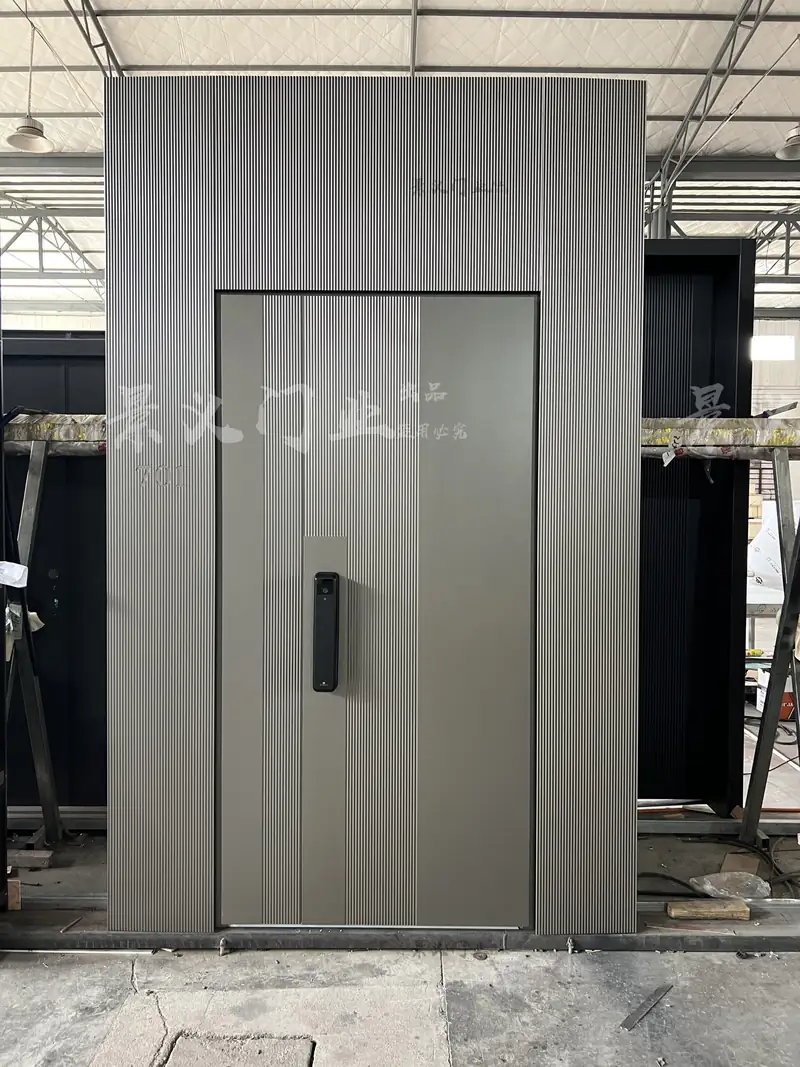
A smart lock cannot simply be bought and fitted: its panels must match the lock body in the leaf, its door-thickness range must cover the real door, the handing must be right, and its cable must pass through the leaf. All of this becomes cut-outs, machined in production.
- Lock body: faceplate, latch and spindle positions and thickness vary, and the panels only fit their own lock body; get the maker's drawing.
- Top-and-bottom bolts: the taller the leaf, the harder it is for one central lock point to hold both ends tight. Tall leaves often use top-and-bottom hooks or multipoint locking; confirm the lock body can drive them.
- Door thickness: if the thickness at the lock, including face panels and decorative layers, exceeds the lock's range, use the maker's extension parts.
- Handing: decides the latch and handle direction; for unequal double and double doors decide the main leaf first, see single, unequal double, double or four-leaf.
- Cable route: with a steel core frame, the lock pocket and cable holes should be laid out with the frame tubes on the production drawing, not drilled during installation.
What about sun, rain and a peephole camera?
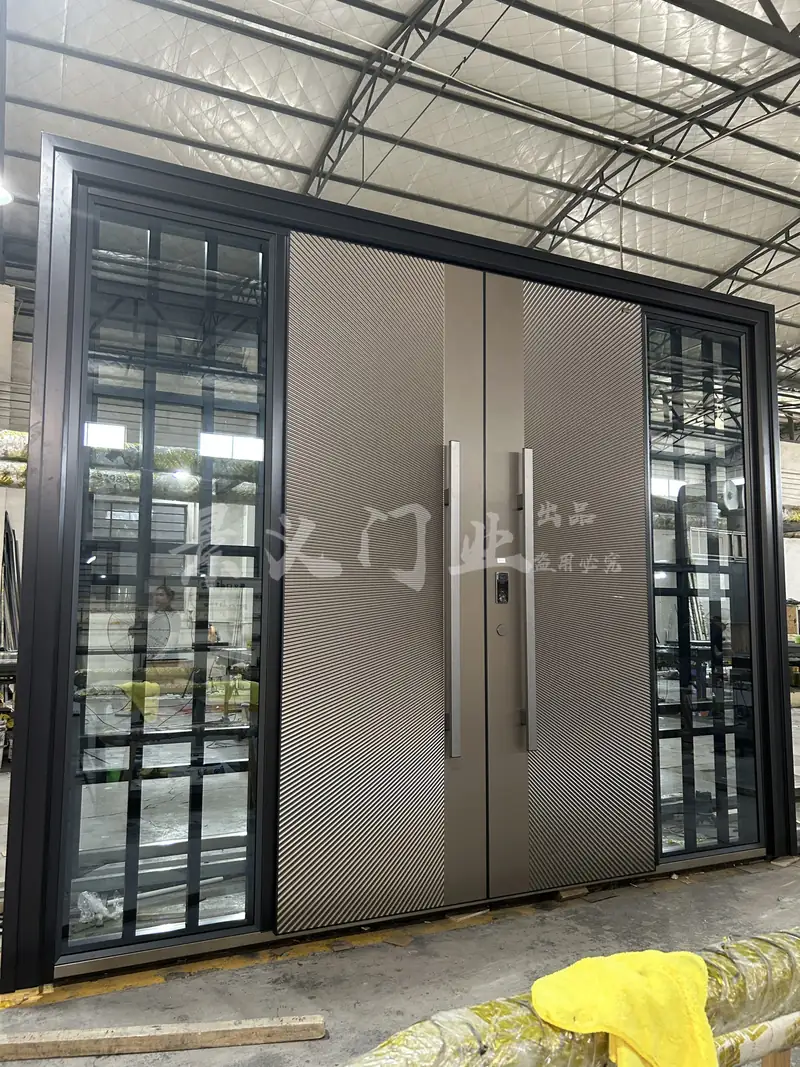
The outside panel takes full sun and rain. With no canopy and a west-facing door, ask the lock maker whether the panel suits that, then consider a canopy. With a peephole camera, decide what it films, where the video is stored and who can see it.
Do not aim the camera at neighbours' doors and windows; for cloud storage, ask about encryption; delete users and data before selling the house or changing the lock. For the door itself, see choosing a villa door for rain, heat and strong sun.
Which lock suits which situation?
No lock suits every household. Start with who uses the door, how much sun the entrance gets and how cold the winter is, then look at the number of leaves and the door height, and compare with the table below:
| Situation | Choose | Watch |
|---|---|---|
| Older people or children | Fingerprint or face, plus PIN | Let them try it in person |
| Someone with often wet, peeling or faint fingerprints | Mainly face or PIN | Enrol several fingers |
| West-facing or backlit entrance | Fingerprint plus PIN; try face first | Outside panel conditions; a canopy |
| Housekeepers or builders coming and going | Networked, with time-limited keys | Delete them afterwards |
| Extra-tall or offset pivot doors | A lock body driving top-and-bottom hooks or multipoint locks | Settle the cable route early |
| Unequal double or double doors | Lock on the main leaf | Fix the main leaf and handing first |
What must be confirmed before the leaf is made?
Fix the smart lock model before the leaf goes into production, because the lock pocket, cable holes and panel positions are machined then, and changing a finished door is hard. Confirm each item and write it into the order specification sheet:
- Lock brand, model, colour and unlocking methods;
- Lock body drawing: faceplate, latch and spindle positions;
- Actual leaf thickness at the lock and the lock's door-thickness range;
- Handing and main leaf;
- Top-and-bottom hooks or multipoint locking, and rod length;
- Battery type, mains voltage and cable route, emergency power port;
- Cylinder grade, number of keys, standard and test documents;
- Stand-alone or networked; whether the app works locally;
- Orientation, canopy and lowest winter temperature;
- Who fits and commissions the lock; who handles faults; warranty period.
For the whole project, use the project pre-check; see also the FAQ.
How is the lock specified when you order from Jingyi?
Jingyi (Zhejiang Jingyi Door Industry Co., Ltd., factory in Wuyi, Zhejiang) has Yinhe (银河) G62 and G71 lock options on record, confirmed for each order. Smart locks can be chosen by lock model, but the cut-outs in the door, the lock body specification, the power supply, the network conditions and what after-sales service covers must be confirmed in advance.
The door core frame and core sheet are galvanised steel, and the lock pocket and cable holes should be laid out with the core on the production drawing. In China, projects in other cities are coordinated from the factory with local partners, and what is included (measuring visit, removal of the old door, lifting, installation) is confirmed per order. For export orders, your local installers fit the door from our installation drawings with remote guidance; we do not send crews abroad. Send details by WhatsApp +86 156 5891 0546 or to sales@dooream.com (Dooream is our export brand), or see Contact.
Frequently asked questions
Should an entrance door smart lock use fingerprint or face recognition?
Either works; the recognition technology is what matters. Shanghai's market regulator says semiconductor (live-finger) fingerprint sensing is more secure than optical sensing. In a 2026 comparative test by the Beijing, Tianjin and Hebei consumer associations, 3 face recognition locks could be opened with a flat photo taken by an infrared camera; the associations advise 3D liveness detection such as structured light or binocular infrared. If someone at home has faint or often wet fingerprints, rely mainly on face or PIN.
Does a smart lock still need a mechanical key?
Yes. When the battery is flat or the electronics fail, the mechanical key is the emergency way in. GA 374-2019 requires the emergency mechanical cylinder of an electronic anti-theft lock to resist breaking or opening for a net working time of at least 15 min; GA/T 73-2015 grades mechanical anti-theft locks A, B and C, with grade C the most resistant to attack.
When should the smart lock for a custom entrance door be chosen?
Before the leaf is made. The lock pocket, cable holes and panel positions are machined in production, so confirm the cut-outs, lock body specification, door-thickness range, handing, power supply, network conditions and what after-sales service covers in advance. Jingyi has Yinhe (银河) G62 and G71 lock options on record, confirmed for each order.
Sources: National standards full-text system: notice on publishing the full texts of China National Standards Announcement No. 22 of 2025 (GB 21556.2-2025, issued 29 August 2025, in force 1 March 2026) (in Chinese);Codeofchina: GB 21556.2-2025 standard summary (scope; security grades A, B and C);Shaanxi Administration for Market Regulation: implementation rules for quality inspections of locks (electronic door locks), 2026 (in Chinese);Beijing Municipal Administration for Market Regulation: notes on the main failed items in inspections of security doors and locks (April 2025) (in Chinese);Public security standardisation information platform: GA/T 73-2015 mechanical anti-theft locks (in Chinese);Shanghai Municipal Administration for Market Regulation: how to choose an electronic door lock, four tips (28 December 2021) (in Chinese);Beijing Municipal Administration for Market Regulation: Beijing, Tianjin and Hebei consumer associations' smart lock comparative test and buying advice (16 April 2026) (in Chinese)